

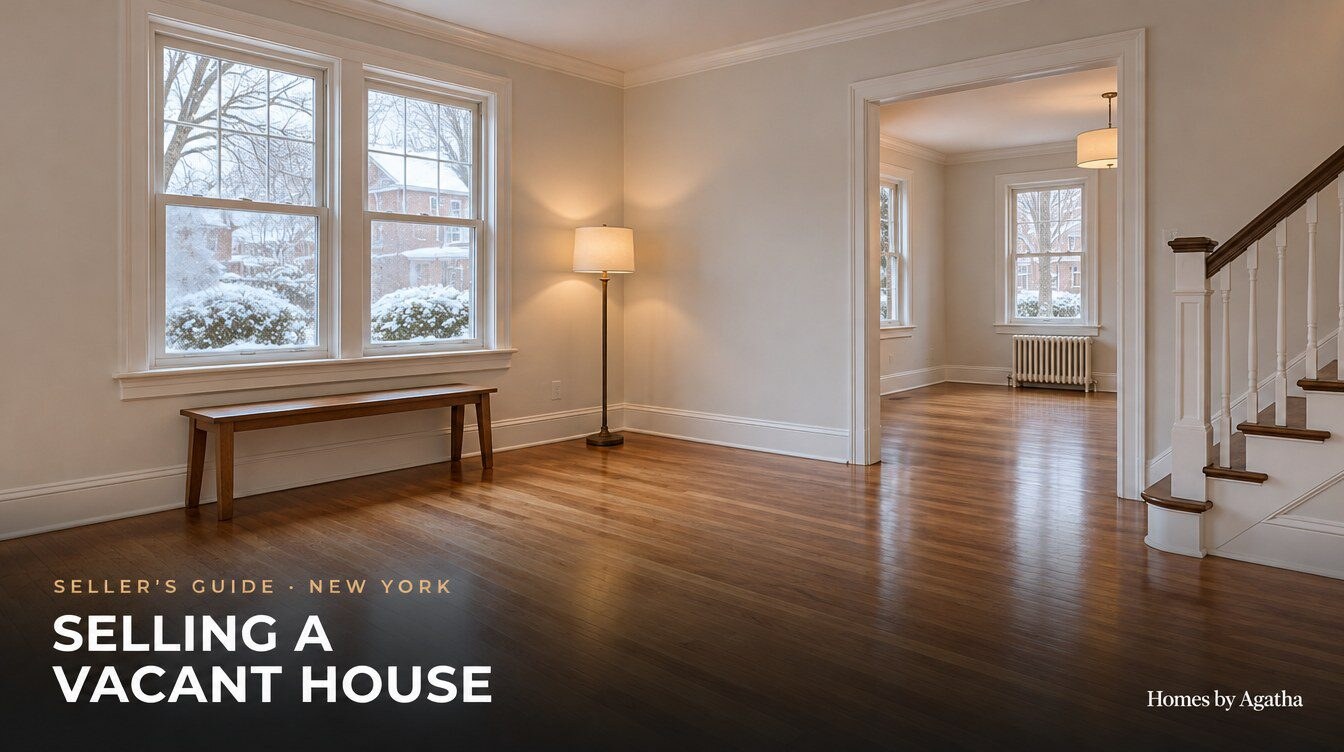
NEW YORK SELLER GUIDE
Selling a Vacant House in New York: Insurance, Utilities, Staging and Closing
Quick Answer
Yes. Selling a vacant house in New York is common after a move, a death in the family or a job transfer. The keys are confirming vacant-home insurance, keeping utilities on for showings and inspections, protecting pipes in winter, staging at least the main rooms, and delivering the Property Condition Disclosure Statement before the buyer signs.
Selling a vacant house is a different job from selling the home you still live in. Nobody is there to notice a slow leak, pick up the mail, shovel the walk or turn the lights on before a showing. The house can look smaller and colder in photos. And every month it sits empty, you keep paying taxes, insurance and utilities on a property that gives you nothing back.
The good news is that an empty house also has real advantages. It can be shown on short notice, it photographs cleanly once it is prepared, it can be repaired or painted without working around anyone’s schedule, and it can close on the buyer’s timeline because nobody has to move out. Most of the problems sellers run into are avoidable with a short checklist and a few phone calls made in the right order.
This guide covers what changes when the house is empty: insurance, utilities and winter care, carrying costs, staging choices, showings and security, the disclosure you still owe, the tax rules that matter when you no longer live there, and the local checks in Queens, Brooklyn, Nassau County and Suffolk County. I have worked with sellers across those areas for 15+ years, in English and Polish, and many of them were selling a house that was already empty. If you want to talk through your own property, call or text me at (646) 250-6512 or use the form at homesbyagatha.com/reach-agatha.
Can you sell a vacant house in New York, and what actually changes?
You can sell a vacant house in New York exactly as you would sell an occupied one. The contract, the attorney review, the buyer’s inspection, the appraisal, the title search and the closing all work the same way. What changes is everything that happens between the day the house empties out and the day you hand over the keys. You are now managing a building remotely, and the market is judging it without any of the warmth that furniture and daily life usually provide.
The three questions to answer first
Before you list, answer three questions. First, is the house insured as a vacant property, or does your policy still treat it as an occupied home? Second, who will check on the house every week, and who has the keys? Third, will the house be shown empty, partly furnished or staged? The answers drive your budget, your timeline and how the listing photos look, so it pays to settle them before the listing goes live rather than after the first weekend of showings.
| Situation | Who usually signs the contract | Extra paperwork to expect |
|---|---|---|
| Owner moved to a new home | The owner (and spouse, if both are on the deed) | Insurance change, STAR notice to the assessor, capital gains timing |
| Inherited house | Executor or administrator named by the Surrogate’s Court | Letters testamentary or letters of administration, date-of-death value |
| Former rental, tenant moved out | The owner | Final meter readings, security deposit closeout, removal of rental registration where applicable |
| Owner relocated out of state | The owner, sometimes through a power of attorney | Power of attorney reviewed by both attorneys, remote closing logistics |
Is selling an empty house harder than selling one you live in?
Selling an empty house is not harder in a legal sense, but it asks more of the preparation. Buyers walking through a bare house notice every scuff, every nail hole and every uneven floorboard, because there is nothing else in the room to look at. Rooms without furniture can read as smaller than they are, and buyers often struggle to judge whether a bed and a dresser will fit. On the other hand, an empty house lets buyers see the actual condition of the walls and floors, which some buyers appreciate.
The bigger risk is time. A vacant house that sits on the market for weeks keeps costing money, and buyers sometimes read a long-vacant listing as a seller under pressure. That can invite lower offers. The answer is not to rush the price down, but to launch with the house clean, repaired, well lit and priced on solid comparable sales from the first day.
| Factor | Vacant house | Occupied house |
|---|---|---|
| Showing availability | Almost any time, with a lockbox and short notice | Must work around the household’s schedule |
| How rooms look in photos | Clean but can look small and cold without furniture | Furniture shows scale, but clutter can distract |
| Repairs and painting | Easy to schedule before listing | Harder while living in the house |
| Risk of unnoticed damage | Higher: leaks, frozen pipes and break-ins can go unseen | Lower: someone is there every day |
| Carrying costs | Paid on top of your current housing | Usually part of your normal budget |
| Closing flexibility | High: nobody needs to move out | Depends on the seller’s next home |
When I prepare an empty house for the market, I look at it the way a buyer will: walking in the front door with nothing to distract from the walls, the light and the smell. Fresh paint in a neutral color, clean windows, working light bulbs in every fixture and a professional cleaning usually do more for an empty house than any single expensive upgrade.
What insurance do you need while the house sits empty?
Insurance is the first call to make, ideally before the house is empty. Many standard homeowners policies are written for a house the owner lives in. Once a house has been vacant or unoccupied for the period stated in the policy, coverage for certain losses can be limited or excluded, and the losses most likely to happen in an empty house, such as vandalism, broken glass and water damage from a burst pipe, are often the ones affected. The exact rules are in your policy’s conditions, so read that section or ask your agent to read it with you.
Vacant versus unoccupied
Insurers often draw a line between a house that is unoccupied and one that is vacant. An unoccupied house still has furniture and belongings but nobody living in it, for example while the owner is away or in a care facility. A vacant house has been emptied of most contents. The two can be treated differently in the same policy, so tell your insurance agent exactly what is in the house and how long you expect it to stay empty.
Questions to ask your insurance agent
- Does my current policy still cover the house once it is empty, and for how long?
- Which losses are limited or excluded after that period: vandalism, glass, water, theft?
- Do I need a vacant home insurance policy or an endorsement, and what does it cost?
- Are there conditions I must meet, such as keeping the heat on or having the house checked on a schedule?
- Does liability coverage stay in place for visitors, inspectors and contractors?
- For an inherited house: who is the named insured now, and does the estate need its own policy?
Write down the answers, the date and the agent’s name. If anything goes wrong while the house is on the market, that record matters. If you are an executor, keeping the house properly insured is part of protecting the estate’s main asset, and your estate attorney will want to see the policy.
Should you keep the utilities on and winterize the house?
Keep the utilities on. Buyers expect to turn on lights, run the faucets and feel the heat when they walk through. The buyer’s home inspector needs electricity, water and gas or oil to test the boiler or furnace, the water heater, the plumbing and the outlets. An appraiser may note a house with no utilities, and some lenders will ask questions about a property that cannot be tested. Shutting everything off to save a few dollars a month usually costs more in delays than it saves.
Heat and frozen pipes
New York winters are the biggest physical risk to an empty house. A boiler that runs out of oil, a furnace that fails, or a thermostat turned all the way down can freeze pipes in a single cold night, and a burst pipe in an empty house can run for days before anyone notices. Keep the heat on at a low but steady setting, make sure the fuel tank is filled if the house uses oil, and have a smart thermostat or a temperature alert installed if possible, so you hear about a heating failure the same day.
If the house will sit empty for a long time over the winter and you decide to winterize it, have a licensed plumber do it: draining the supply lines, the water heater and the heating system as needed, and putting non-toxic antifreeze in the traps. Then tell your listing agent and every buyer’s agent. A winterized house has to be de-winterized before the buyer’s inspection, usually by the same plumber, so that the inspector can test the plumbing and heating. Plan that step into the contract timeline.
Water, gas and electric accounts
Keep the accounts in the owner’s or estate’s name until closing. In New York City, water and sewer charges are billed by the property and become a lien if unpaid, and the closing attorney will check for open balances. Order final meter readings for the day of closing, not the day you moved out. In Nassau and Suffolk, the same advice applies to the local water district and to the utility companies serving the house.
- Heat on at a steady low setting; fuel delivered if the house uses oil.
- Electricity on, with lamps or lights on timers in the front rooms.
- Water on, unless a plumber has winterized the house on purpose.
- Smoke and carbon monoxide alarms tested, with fresh batteries.
- Internet only if you use cameras, a thermostat or alarm monitoring.
Is your empty house ready for winter showings?
I can walk through the house with you, list what needs to happen before photos, and coordinate keys and access with your plumber, cleaner and insurance inspector. Call or text (646) 250-6512.
What does it cost to carry an empty house while it is for sale?
Carrying costs are the bills you keep paying on the house between move-out and closing. They are easy to underestimate because they arrive from different places on different schedules. Before you set a price and a timeline, list each one with its real monthly amount from your own bills. That number tells you what each extra month on the market costs you, and it is one of the most useful inputs in any pricing conversation.
| Carrying cost | Where to find the real number | Notes for a vacant house |
|---|---|---|
| Property taxes | NYC Department of Finance bill, or the town or county tax bill on Long Island | Exemptions tied to living in the house may need to be updated |
| Insurance | Your current policy or the vacant home policy quote | Often higher for a vacant property |
| Mortgage or home equity line | Monthly statement | Keep paying through closing; payoff is ordered by the closing attorney |
| Heat, electricity, gas | Last winter’s and summer’s bills | Lower than when occupied, but not zero |
| Water and sewer | Water bill for the property | Unpaid balances can delay the closing |
| Lawn care and snow removal | Quote from a local service | Needed every week of the season, not just before showings |
| Cleaning and minor repairs | Quotes before listing | Dust and dead insects build up in empty houses; plan a touch-up clean |
| Alarm, cameras or a house-check service | Provider quote | May be required by the vacant home policy |
Add those lines together and you have a monthly figure. Multiply it by a realistic number of months from listing to closing, including the time a buyer needs for the mortgage commitment, and you will see why pricing an empty house correctly at launch matters so much. A price that is too high often leads to more months of carrying costs and a later price cut, which together cost more than starting at the right number.
How pricing works when the house is empty
Pricing a vacant house uses the same method as any other: recent sales of similar homes nearby, adjusted for size, condition, lot, layout and features. A comparative market analysis, or CMA, is an opinion of value prepared by a real estate professional from those sales. It is not an appraisal. What changes with a vacant house is that condition is fully visible, so repairs and updates that you decide not to make should be reflected honestly in the price. For a free opinion of value on a Queens property, start with the Queens home value request.
Should you stage an empty house, leave it bare, or use virtual staging?
Staging is the question every owner of an empty house asks, and the honest answer depends on the house, the budget and the buyer you expect. A bare house can sell well when it is spotless and the rooms are easy to read. A living room with odd proportions, a narrow dining area or a bedroom that looks too small without a bed usually benefits from a few pieces of furniture that show how the space works.
| Option | What it involves | When it fits |
|---|---|---|
| Empty, deep cleaned | Professional cleaning, fresh paint, every bulb working, windows washed | Simple layouts, buyers planning renovations, tight budgets |
| Partial staging | Furniture in the living room, kitchen or dining area and the main bedroom | Most vacant houses; shows scale where buyers need it most |
| Full staging | A stager furnishes every main room with rented pieces | Larger or higher-priced homes where photos drive showings |
| Virtual staging | Furniture added digitally to the listing photos only | Low budget; photos must be clearly labeled and the empty versions shown too |
What partial staging usually covers
If you stage only part of the house, put the furniture where buyers decide. That is usually the living room, because it is the first room most buyers see, the kitchen or dining area, because buyers want to know a table fits, and the main bedroom, because an empty bedroom often looks smaller than its actual size. A few towels in the bathroom, a rug in the entry and a lamp in a dark corner help the rest of the house feel cared for without the cost of a full stage.
Virtual staging can help online, but the house buyers walk into will be empty. Label every virtually staged photo, include the unstaged version, and never digitally hide defects, cover stains or change finishes. Buyers who feel misled by photos tend to arrive at the showing already skeptical.
How do showings and security work in a vacant house?
Showings in a vacant house usually run through a lockbox controlled by the listing agent, with buyer’s agents booking appointments through the showing system and the listing agent confirming each one. This makes the house easy to see, which is one of the real advantages of selling a vacant home. It also means more people are coming and going without the owner present, so a few simple routines keep the house protected.
A weekly check routine
- Walk every room, the basement and the attic, looking and smelling for water.
- Check the boiler or furnace, the water heater and the thermostat setting.
- Flush toilets and run each faucet briefly so traps do not dry out and release sewer smell.
- Pick up flyers, packages and any mail that still arrives; forward mail through the post office.
- Confirm every door and window is locked after showings, including basement doors.
- Replace burned-out bulbs and empty any trash left by visitors or contractors.
Lights on timers, a mowed lawn in summer and a cleared walk in winter make the house look lived in from the street. Motion lights at the side and rear doors, a video doorbell and a monitored alarm add a layer of protection, and some vacant home policies ask for one of them. Tell a trusted neighbor that the house is for sale and give them your number, so they can call if they see something unusual.
Keys and access
Keep a written list of everyone who has a key: you, the listing agent’s lockbox, a family member, the cleaner, the plumber. When contractors finish, collect their keys or change the lock. If the house was inherited and several siblings have keys, agree on one person who coordinates access, so nobody is surprised by a visit or a change.
What must you disclose when selling a vacant house in New York?
An empty house does not change your disclosure duties. In New York State, the Property Condition Disclosure Act requires most sellers of one- to four-family homes to complete the Property Condition Disclosure Statement and deliver it to the buyer before the buyer signs a binding contract of sale. Since March 20, 2024, sellers can no longer give the buyer a $500 credit instead of the form, and the statement now includes questions about flood history, flood zones and flood insurance. Certain transfers are exempt, including some sales by a fiduciary administering an estate; your attorney confirms whether your sale qualifies.
The challenge with a vacant house is knowledge. If you have not lived in the house recently, or if it belonged to a parent, you may not know the answers to every question. The form allows “unknown” as an answer, but it must be honest: you disclose what you actually know. Gather what you can before you complete it: past repair invoices, permits, the boiler service record, any insurance claims, and what neighbors or family members remember about water in the basement or a past roof repair.
Things that often happen in an empty house
Vacant periods create their own disclosure items. A pipe that froze and was repaired, a roof leak discovered after move-out, a break-in, a pest problem or a sewer backup are all events your attorney will want to know about. Fix what you can, keep the invoices, and discuss with your attorney how each item is reflected in the disclosure and the contract.
Smoke and carbon monoxide alarms
In New York City, the transfer tax return for a one- or two-family house is accepted only with an affidavit signed by the seller and the buyer confirming that an approved, working smoke detector is installed, a rule added to the city’s Administrative Code by Local Law 81 of 1989. Carbon monoxide alarms are also required in New York homes. In an empty house, batteries die quietly, so test every alarm before listing and again before closing.
If you are selling a vacant house in poor condition and plan to sell it without repairs, the rules are the same, and the details are covered in the guide to selling a house as is in New York. Selling as is limits what you will fix, not what you must disclose.
Not sure what to put on the disclosure form?
If you have not lived in the house for a while, I can help you gather the records and questions to bring to your attorney before the form goes to a buyer. Call or text (646) 250-6512.
Selling a vacant home after a move, an inheritance or a foreclosure notice
Why the house is empty shapes the paperwork. The three most common situations each come with a rule worth knowing before you set a timeline.
You moved out and bought your next home
The federal home sale exclusion lets you exclude up to $250,000 of gain, or up to $500,000 for most married couples filing jointly, if you owned the home and used it as your main home for at least two of the five years before the sale, according to IRS Topic 701, Sale of your home. Because the five-year window ends on the sale date, time works against a house that sits empty. An owner who lived in the house for exactly two years before moving out generally has to close within three years of moving out to still meet the use test. Ask your tax professional to check your own dates.
Property tax benefits tied to living in the house also need attention. The STAR benefit is for a primary residence, and owners agree to notify the assessor when they move to another primary residence. In New York City the assessor is the Department of Finance; on Long Island it is the town or county assessor. The state explains how to give up a STAR benefit on its STAR renunciation page. Handle it promptly; misstating a primary residence can bring penalties.
You inherited the house
When the owner has died, the person who signs the contract is usually the executor named in the will, or an administrator appointed by the Surrogate’s Court, once the court issues letters testamentary or letters of administration. For federal tax purposes, the basis of inherited property is generally its fair market value on the date of death, as the IRS explains in Publication 551, so a sale soon after death often produces little taxable gain. A date-of-death valuation is worth ordering early. The steps of a court-supervised sale, and how an executor works with the family and the attorney, are covered on the probate real estate page.
Inherited houses are the most common vacant houses I see, and they often need the most preparation: decades of belongings, older systems, and several family members who all need to agree. Start with insurance and heat, then the cleanout, then the listing. Doing them in that order protects the house while the family makes decisions.
You are behind on the mortgage
If payments are behind and the house is empty, act early and talk to your lender and an attorney or a housing counselor. New York’s law on vacant and abandoned property, Real Property Actions and Proceedings Law section 1308, requires mortgage holders to inspect, secure and maintain vacant one- to four-family homes that are in foreclosure, and the state Department of Financial Services runs a registry of those properties. Those duties do not make the debt go away. A sale while you still control the house usually leaves you more options than waiting.
What taxes and closing costs apply when selling a vacant house?
A vacant house pays the same seller closing costs as any other sale. In New York City, the seller usually pays the city’s Real Property Transfer Tax, which the NYC Department of Finance sets at 1% of the price for residential sales of $500,000 or less and 1.425% for residential sales above $500,000, applied to the whole price. The seller also usually pays the New York State transfer tax of $2 for every $500 of price, plus the seller’s attorney fee and the broker’s commission agreed in the listing agreement.
| Seller cost | Queens and Brooklyn | Nassau and Suffolk |
|---|---|---|
| NYC Real Property Transfer Tax | 1% up to $500,000; 1.425% above | Does not apply |
| NYS transfer tax | $2 per $500 of price | $2 per $500 of price |
| Attorney fee | Agreed with your attorney | Agreed with your attorney |
| Broker commission | Set in the listing agreement | Set in the listing agreement |
| Mortgage payoff and lien releases | From the sale proceeds at closing | From the sale proceeds at closing |
| Carrying costs to the closing date | Taxes, water, insurance adjusted at closing | Taxes, water district, insurance adjusted at closing |
At closing, property taxes and some utilities are adjusted between buyer and seller to the closing date. If you prepaid taxes for a period after the closing, you are credited for that part. For the full breakdown of seller and buyer costs in New York City, including which party pays which tax, see the Queens closing costs guide.
Delivering the house vacant at closing
Most New York residential contracts require the seller to deliver the house vacant and broom clean at closing, with all personal property removed except the items listed in the contract. With an empty house this is usually simple, but check the basement, the attic, the garage and any shed. Old paint cans, a broken freezer or a pile of tiles can lead to a holdback or a last-minute argument at the final walkthrough. Schedule the last cleanout a few days before closing, not the morning of.
Selling a vacant house in Queens, Nassau County and Suffolk County: local checks
The basics are the same across the area, but the local details differ. A few checks done early prevent most of the late surprises I see at closing tables.
Queens and Brooklyn
In New York City, the buyer’s attorney and title company will look at the Department of Buildings record for open permits, open violations and the certificate of occupancy, if one exists for the house. An empty house is often where an owner did renovation work years ago, and an open permit that was never signed off can delay a closing. Look up the property on the Department of Buildings systems before you list, and ask your attorney how to close out anything you find.
Snow is a practical issue. Under city Sanitation rules, owners must clear the sidewalk in front of the property within four hours after snow stops falling, when it stops during the day, with different deadlines for evening and overnight snowfall. With nobody living in the house, arrange a snow service before the first storm. For the full selling process in the borough, see how to sell your home in Queens, and for citywide steps, the guide to selling a home in NYC.
Nassau County
Owners searching for help with a vacant house in Nassau County face the same insurance, heat and disclosure questions, plus local ones. Building permits are issued by the town or incorporated village, not the county, and buyers’ attorneys check for open permits and certificates of occupancy or completion for finished basements, decks and additions. Some towns and villages have their own rules for vacant or rental properties; call the building department before you list. The Nassau County home selling page covers how I work with sellers there.
Suffolk County
In Suffolk County, many houses use a cesspool or septic system and some use a private well, and buyers often want those inspected. An empty house with little water use for months can hide a septic problem until the buyer’s inspection runs water through it, so a pre-listing pump-out and inspection is worth discussing. Open permits are again a town or village matter. For the seller’s view of the county, see selling your home in Suffolk County.
A step-by-step plan for selling a vacant house
This is the order I recommend for most owners of an empty house. Some steps run in parallel, but the first three protect the house and should never wait.
- Call your insurance agent. Confirm coverage for a vacant house, add an endorsement or a vacant home policy if needed, and note any conditions.
- Secure heat and utilities. Heat on, fuel delivered, alarms tested, lights on timers, and a temperature alert if possible.
- Set up a weekly check. One named person, a written key list and a short checklist after every visit.
- Gather documents. Deed, mortgage statement, tax bill, water bill, repair invoices, permits, survey, and for an estate, the court letters.
- Clean out and repair. Remove belongings, make small repairs, paint where needed, and order a professional cleaning.
- Decide on staging. Empty, partial, full or virtual, based on the layout and the expected buyer.
- Price from comparable sales. Review an opinion of value and your monthly carrying cost before choosing a list price.
- Prepare the disclosure. Complete the Property Condition Disclosure Statement with your attorney, so it is ready before any contract is signed.
- List with clear showing instructions. Lockbox, booking rules, notes on winterization, and a reminder to lock every door.
- Negotiate and sign. Review offers for price, financing and closing date; your attorney prepares the contract.
- Get through inspection and appraisal. Make sure utilities are on and the house is de-winterized if needed.
- Close and hand over. Final cleanout, final meter readings, cancel the vacant home policy only after the deed transfers.
Key Takeaways
- Selling a vacant house follows the same legal steps as any sale; the difference is caring for an empty building while it is on the market.
- Call your insurance agent first: many homeowners policies limit coverage once a house has been vacant for the period in the policy.
- Keep the heat and utilities on for showings, the inspection and the appraisal, and protect the pipes through the winter.
- The Property Condition Disclosure Statement is still due before the buyer signs, and the $500 credit option ended on March 20, 2024.
- Know your timing rules: the IRS two-out-of-five-year test for a former main home, and the date-of-death basis for an inherited house.
Ready to sell your empty house?
I work with owners and executors selling vacant houses in Queens, Brooklyn, Nassau County and Suffolk County, in English and Polish. We can start with a walkthrough and an opinion of value, then build the plan around your timeline.
Frequently asked questions about selling a vacant house
Is it better to sell a house empty or furnished?
It depends on the house. A spotless empty house with a simple layout can sell well, but most empty homes benefit from partial staging in the living room, the kitchen or dining area and the main bedroom, because furniture shows buyers the scale of each room. Remove crowded or personal furniture before photos either way.
Does homeowners insurance cover a vacant house?
Not always. Many homeowners policies limit or exclude certain losses, such as vandalism, broken glass or water damage, once a house has been vacant or unoccupied for the period stated in the policy. Ask your insurance agent whether you need a vacant home policy or an endorsement before the house is empty.
Should I turn off the utilities in a vacant house I am selling?
No. Keep electricity, heat and water on so buyers can see the house properly and the inspector can test the systems. In winter, keep the heat at a steady low setting or have a licensed plumber winterize the house, and remember it must be de-winterized before the buyer’s inspection.
Do I still need to fill out the disclosure form if I never lived in the house?
Usually yes. Most sellers of one- to four-family homes in New York must deliver the Property Condition Disclosure Statement before the buyer signs the contract, and the $500 credit option ended on March 20, 2024. You answer from your actual knowledge, and certain transfers, including some sales by an estate fiduciary, are exempt. Your attorney confirms which applies.
How long can a house be empty before I lose the capital gains exclusion?
The IRS test requires that you owned and lived in the home as your main home for at least two of the five years before the sale. If you lived there exactly two years before moving out, you generally need to sell within three years of moving out. A tax professional should check your exact dates.
Can a real estate agent sell a vacant house if I live out of state?
Yes. The listing agent handles showings through a lockbox, coordinates cleaners and contractors, and keeps you updated. Contracts can be signed electronically, and the closing can often be handled through your attorney with a power of attorney or signed documents sent in advance, as your attorney arranges.
Summary and your next step
Selling a vacant house in New York works like any other sale on paper, but it rewards owners who protect the building first: insurance confirmed, heat and utilities on, a weekly check, and a plan for winter. Clean, repair and stage where buyers need help picturing the space, price from real comparable sales, and have the disclosure ready before any contract. If you are selling an empty house in Queens, Brooklyn or Long Island, reach out to talk through your property and timeline.
This article is for general informational purposes only and reflects conditions that may change. It is not legal, tax, insurance or financial advice; consult a licensed New York attorney, a tax professional and your insurance agent about your own situation. Tax rules described here reflect the cited government sources as of October 2026. Real estate brokerage services are offered by Agatha Lubas, Licensed Associate Real Estate Broker, NY License #10301213345, Keller Williams Realty Liberty, 96-10 101st Avenue, Ozone Park, NY 11416. The NYS Disclosure Form for Buyer and Seller, the NYS Housing and Anti-Discrimination Disclosure / Fair Housing Notice, and the brokerage’s Standard Operating Procedures are available on request. Equal Housing Opportunity.

Agatha Lubas works with buyers, sellers and executors throughout Queens, Brooklyn, Nassau County and Suffolk County, helping owners prepare, price and sell homes that are already empty, from inherited houses to former rentals. She serves clients in English and Polish.
Work with Agatha