

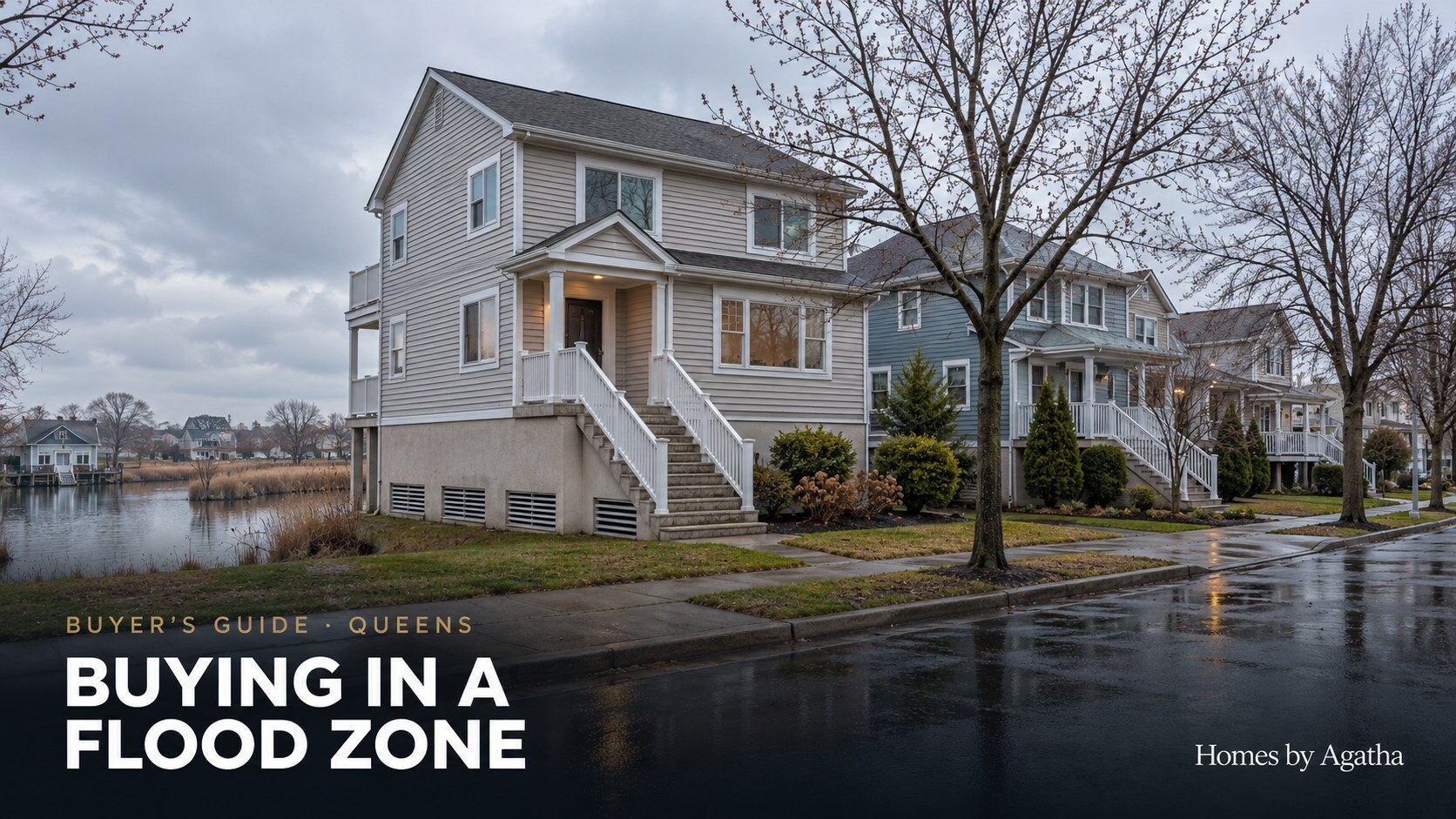
QUEENS BUYER GUIDE
Buying a House in a Flood Zone in NYC: Maps, Insurance and Disclosures
Quick Answer
You can buy, but check three things before you sign a contract. Look up the address on FEMA’s maps and the city’s preliminary maps, get a flood insurance quote, and read the seller’s flood answers on the disclosure statement. With a federally backed mortgage, a house in a high-risk zone must carry flood insurance.
Buying a house in a flood zone in NYC is a normal part of the market here, not an exception. Large parts of southern Queens, the Rockaways, Howard Beach, Broad Channel, College Point, Whitestone and the shoreline of Brooklyn and Staten Island sit on or near FEMA’s flood maps. Many of those houses are well built, well kept and sold every year. What changes is the homework: the map, the insurance, the seller’s disclosures and the inspection all carry more weight, and they need to happen in the right order.
I have worked with buyers and sellers in Queens, Brooklyn and Long Island for 15+ years, in English and Polish, and the buyers who do well in flood zones are the ones who price the insurance before they price the house. This guide explains how the maps work in New York City, when flood insurance is required, what drives its cost, what a New York seller must now tell you about flooding, and how to plan the contract and closing so nothing surprises you at the end.
Buying a house in a flood zone in NYC starts with the map
A flood zone is an area that FEMA, the Federal Emergency Management Agency, has mapped by flood risk on its Flood Insurance Rate Maps, known as FIRMs. The maps drive two things a buyer cares about: whether a lender will require flood insurance, and how the city regulates construction and renovation. Everything else in this guide builds on that first lookup.
What “100-year” and “500-year” really mean
FEMA’s high-risk area is called the Special Flood Hazard Area. People often call it the 100-year floodplain, which sounds like a flood that comes once a century. That is not what it means. It is land with at least a 1% chance of flooding in any given year. Over the length of a 30-year mortgage, FEMA describes that as roughly a one-in-four chance of at least one flood. The 500-year floodplain is the moderate-risk area, with about a 0.2% annual chance. Both labels appear on the New York disclosure form a seller must give you, so it helps to know them before you read it.
A flood zone is a fact about the land, not a verdict on the house
Two houses on the same block can carry very different risk. One may have its first floor several feet above the expected flood level, with the boiler and electrical panel moved up from the cellar. The house next door may have a finished basement at grade. The zone tells you where to look harder. The house itself, and its paperwork, tell you how much the zone matters.
Why this matters most in Queens
Queens has long stretches of shoreline along Jamaica Bay, the Rockaway peninsula, Flushing Bay and Little Neck Bay, plus low inland areas that collect rain. Neighborhood guides such as buying a home in Howard Beach and buying a home in Arverne cover the local streets. This guide is the general method that applies to all of them.
FEMA flood zones explained: AE, VE, X and shaded X
The letter code on the map is the single most useful piece of information in a flood-zone purchase. It tells you whether insurance is mandatory with a federally backed loan and gives your insurance agent the starting point for a quote.
| Zone on the map | What it means | Flood insurance with a federally backed mortgage |
|---|---|---|
| VE | Coastal high-hazard area: at least a 1% annual chance of flooding plus wave action | Required |
| AE | High-risk area with at least a 1% annual chance of flooding and a mapped base flood elevation | Required |
| A, AO and similar A zones | High-risk areas, sometimes without a detailed flood elevation | Required |
| Shaded X | Moderate-risk area, the 500-year floodplain, about a 0.2% annual chance | Not required by federal rule, often recommended |
| Unshaded X | Minimal mapped risk from rivers and the coast | Not required; rain and sewer flooding can still happen |
Flood zone AE vs X
The question buyers ask most is the difference between flood zone AE vs X. In an AE zone, the house is inside the high-risk area, a lender making a federally backed loan must require flood insurance, and the map shows a base flood elevation, the height floodwater is expected to reach in a 1% annual chance flood. In an X zone, insurance is not federally required, and the premium is usually lower. The line between the two can run through the middle of a block, and sometimes through the middle of a lot.
The base flood elevation
In A and V zones, the base flood elevation is the number that matters most. If the lowest floor of the house sits above it, risk and premiums tend to be lower. If the lowest floor, including a basement, sits below it, both tend to be higher. You only learn where the house sits relative to that number from an elevation certificate, which we cover below.
VE zones are a different conversation
VE zones face waves on top of rising water. Construction rules are stricter, renovations are more limited, and insurance is generally more expensive. A VE purchase deserves an early call with an insurance agent and an architect or engineer, before you put down a contract deposit.
Which flood maps count in New York City
New York City has an unusual situation: two sets of maps matter at the same time, for different purposes. Buyers who check only one of them can come away with the wrong picture.
The 2007 effective maps set insurance rules today
According to the city’s NYC flood maps page, flood insurance requirements and rates in the five boroughs continue to be based on FEMA’s 2007 effective FIRMs until new maps are issued. When a lender orders a flood zone determination for your mortgage, it is checking the effective map.
The preliminary maps and the appeal
After Hurricane Sandy in 2012, FEMA released preliminary maps that drew a larger floodplain, then revised them in January 2015. The city filed a technical appeal in June 2015, and in October 2016 FEMA agreed with the city’s findings and said it would produce new maps. As of this writing, the city still describes the new maps as coming in future years, without a fixed date. A house shown outside the high-risk area today could be inside it when the new maps take effect, or the reverse.
The building code uses the more restrictive map
For new construction and major renovation, the city’s flood-resistant construction rules apply to whichever map is more restrictive, the 2007 effective map or the preliminary map, and add extra height, called freeboard, on top. That matters if you plan to add a floor, rebuild after damage or renovate heavily. A house can be outside the insurance requirement and still inside the construction rules.
The NYC flood zone map tools
The easiest public way to see both maps on one screen is the city’s NYC Flood Hazard Mapper, run by City Planning, which lets you search by address and toggle the 2007 effective and preliminary layers. FEMA’s own Flood Map Service Center shows the official effective panels. For a purchase, use both, and save screenshots for your file.
How to check an address before you make an offer
The best time to learn about flood risk is before you fall in love with the kitchen. A short check takes less than an hour and changes how you offer.
A pre-offer flood checklist
- Search the address on the NYC Flood Hazard Mapper and note the zone on the 2007 effective map and on the preliminary map.
- Check FEMA’s Flood Map Service Center for the effective panel and confirm the zone code.
- Look at the city’s stormwater flood maps for rain-driven flooding, which FEMA maps do not show.
- Ask the listing agent for the seller’s Property Condition Disclosure Statement, the elevation certificate if one exists, and the current flood insurance declarations page.
- Send the address and the elevation certificate to an insurance agent who writes flood policies and ask for a quote.
- Walk the street after a heavy rain if you can, and look at the cellar or basement walls, floor drain and stairs during the showing.
Add the premium to your monthly budget
Flood insurance is a monthly cost like taxes and the mortgage. Add the quoted premium to your budget using our mortgage calculator, together with property taxes and homeowners insurance, and see whether the house still works before you bid. A buyer who learns the premium after the contract has less room to plan.
Ask the right questions at the showing
Has the house taken water? When, and how high? Where are the boiler, water heater and electrical panel? Is there a sump pump or a backwater valve on the sewer line? Has the seller received any FEMA or SBA disaster assistance? The seller does not have to answer verbally, but the disclosure form asks most of these questions in writing.
Looking at a house in a flood zone?
I will pull the map, ask for the seller’s flood records and help you get an insurance quote before you make an offer. Call or text (646) 250-6512.
When flood insurance is required in NYC
Flood insurance is required by federal law, not by the city, and only in a specific situation: when the building is in a high-risk flood area and the mortgage comes from a federally regulated or federally backed lender. As FEMA’s flood insurance page puts it, homes in high-risk flood areas with mortgages from government-backed lenders are required to have flood insurance.
The lender’s flood determination
Your lender will order a flood zone determination on the standard federal form. If the building is in an A or V zone on the effective map, the lender will require flood insurance before closing, usually for at least the lower of the loan amount or the maximum available under the National Flood Insurance Program. The determination is the lender’s call, so a buyer should not rely only on a listing description that says “not in a flood zone.”
Cash buyers and X zones
If you pay cash, or the house is in an X zone, no federal rule forces you to buy flood insurance. That does not mean the risk is zero. A large share of flood damage in the city comes from heavy rain and sewer backup, which can reach houses far outside the mapped zones. Many owners in shaded X areas carry a policy anyway, and premiums there are often modest.
Co-ops and condos
In a co-op or condo, the building usually carries the flood policy on the structure, and the cost is built into maintenance or common charges. Ask the managing agent for the building’s flood policy and any history of claims, and ask your own agent whether you need contents coverage for your unit. Our NYC home buying process guide explains where the building documents fit into a co-op or condo purchase.
Disaster assistance can come with strings
If a previous owner received federal disaster assistance for flood damage, the property may carry a requirement to keep flood insurance in place, and a seller has a duty to pass that information on. The disclosure statement now asks about it directly. Your attorney should confirm what was received and what it requires before you sign.
Flood insurance NYC cost: what drives the premium
There is no single answer to the question of flood insurance NYC cost, and anyone who quotes a citywide average is guessing. Since FEMA moved to its Risk Rating 2.0 pricing, premiums are calculated house by house.
How Risk Rating 2.0 prices a house
Under Risk Rating 2.0, the National Flood Insurance Program looks at the individual building rather than only the zone letter. FEMA’s Risk Rating 2.0 overview explains that premiums reflect each home’s value and its specific flood risk. Factors include distance to the water, the type of flooding the area faces, the cost to rebuild the house, the height of the first floor and the type of foundation.
Increases are capped, but they continue
For existing policies, the same FEMA document explains that annual increases are held to an 18% limit set by Congress, and premiums keep rising gradually until they reach the full-risk rate. That is why the seller’s current premium is not always your future premium. Ask your agent for the full-risk rate as well as the first-year number.
What you can do about the price
- Get the elevation certificate, which can lower the rate when the lowest floor sits well above the flood level.
- Ask about taking over the seller’s existing NFIP policy, which can keep the rate path the seller already had.
- Compare an NFIP quote with private flood quotes.
- Ask how a higher deductible changes the premium.
- Ask whether mitigation work, such as flood vents or moving equipment out of the cellar, would change the rating.
Budget for it with the other closing items
Your lender will usually want the first year of flood insurance paid at or before closing, often with a cushion in escrow. It sits next to title, recording and lender fees in the closing budget. Our guide to Queens closing costs lists those other items.
NFIP vs private flood insurance and what each covers
Most flood policies in New York City are written through the National Flood Insurance Program, but private flood insurance is an option, and federal rules require regulated lenders to accept private policies that meet the federal definition of private flood insurance.
NFIP coverage limits
An NFIP policy for a residential building covers up to $250,000 for the structure and up to $100,000 for contents, and contents coverage is bought separately. For many houses in Queens, rebuilding costs can exceed the building limit, which is one reason some owners add excess or private coverage.
What NFIP covers in a basement
This is the part that surprises buyers. NFIP coverage below the lowest raised floor of the house, including basements, is limited. It generally covers essential equipment such as the boiler or furnace, water heater, electrical panel, and washer and dryer, plus cleanup. It generally does not cover finished walls, flooring, furniture or other belongings kept in a basement. A finished basement in a flood zone is a risk you carry yourself under a standard NFIP policy.
Sewer backup is a separate issue
Standard homeowners policies exclude flood. An NFIP policy covers sewer backup only when it is directly caused by a flood. Water that backs up through a floor drain during a heavy rain, with no general flood around the house, often falls under neither. Many homeowners insurers sell a sewer and drain backup endorsement. Ask for it by name.
Waiting periods and closing
FEMA notes that a new NFIP policy typically has a 30-day waiting period before it takes effect, with exceptions, including coverage required by a lender in connection with a loan. In a purchase with a mortgage, the policy usually takes effect at closing. If you are paying cash, buy the policy early enough that the waiting period ends by the day you take the keys.
Private policies
Private flood insurers may offer higher limits, different basement terms or a lower premium for some houses, and may cost more for others. Read what each policy excludes, check whether the lender will accept it, and remember that switching back to the NFIP later can affect the rate path. A licensed agent who writes both can compare them for you.
Elevation certificates: the document that explains the house
An elevation certificate is a FEMA form prepared by a licensed land surveyor, engineer or architect. It records the height of the lowest floor, the lowest adjacent grade, the location of machinery and the type of building, compared with the base flood elevation on the map.
Why buyers should ask for it
The elevation certificate is the clearest way to see how the house sits relative to expected floodwater. An insurance agent uses it to rate the policy, and an architect uses it to plan any renovation. The New York disclosure form now asks whether one is available and asks the seller to attach a copy if it is. If the seller has one, read it before you make your offer, not after.
If there is no certificate
An elevation certificate is not required to buy an NFIP policy under Risk Rating 2.0, but it can help lower the rate. If none exists, you can hire a surveyor to prepare one, ideally during the contract stage, so you have the answer before the loan commitment. Ask the surveyor for the timeline when you hire your real estate attorney in NYC, so the dates fit together.
What to look for on the form
- The flood zone and base flood elevation used.
- The height of the lowest floor, including any basement or cellar.
- The height of the machinery and equipment, such as the boiler and electrical service.
- Flood openings or vents in an enclosed area below the first floor.
- The date of the certificate, because later work can change the numbers.
Older certificates and later work
If the house was raised, rebuilt or renovated after the certificate was prepared, the form may no longer describe the building. Ask when it was done and whether any work since then changed the lowest floor or moved equipment.
Want the flood paperwork before you commit?
I will request the elevation certificate, the flood policy and the disclosure statement from the listing side and line them up with your insurance agent and attorney. Call or text (646) 250-6512.
What a New York seller must disclose about flooding
New York changed its disclosure rules for flood risk, and the change helps buyers directly. Since March 20, 2024, a seller of a covered one-to-four family house can no longer skip the Property Condition Disclosure Statement by giving the buyer a $500 credit at closing. The form must be completed, signed and delivered before the buyer signs a binding contract.
The flood questions on the form
Under Real Property Law section 462, the statement now asks the seller whether:
- Any part of the property is in a FEMA-designated floodplain.
- Any part is in the Special Flood Hazard Area, the 100-year floodplain, on FEMA’s current maps.
- Any part is in the moderate-risk flood hazard area, the 500-year floodplain.
- The property is subject to a federal requirement to obtain and keep flood insurance.
- The seller or a previous owner received FEMA, SBA or other federal disaster assistance for flood damage.
- There is flood insurance on the property, with a copy of the policy attached.
- A FEMA elevation certificate is available, with a copy attached.
- The seller has filed a flood damage claim with any insurer, including the NFIP.
Other questions on the form cover flooding, drainage or grading problems that caused standing water, and water damage from seepage or a natural flood event.
How to read the answers
“Unknown” is a permitted answer, and you will see it. Treat every “unknown” or “yes” as a follow-up item for your attorney and inspector. A “yes” to a past claim is not a reason to walk away by itself. It is a reason to ask what happened, what was repaired and by whom.
Renters and two-family houses
If you are buying a two-family and plan to rent a unit, New York’s Real Property Law section 231-b requires residential leases to include a flood disclosure: whether the premises are in a mapped floodplain and any known past flood damage. The seller’s existing leases should already include it. Our guide to buying a multi-family home in Queens covers the rest of the rental side.
Inspection and due diligence in a flood-zone house
A general home inspection is the base of your due diligence, but in a flood zone you want the inspector to look at specific things and say so in the report. Our guide to a home inspection in NYC explains how the inspection fits into the contract timeline.
What to ask the inspector to focus on
- Signs of past water in the cellar or basement: staining, efflorescence on masonry, rusted equipment bases, warped stair treads.
- The height and condition of the boiler, water heater and electrical panel.
- A backwater valve on the sewer line, and a sump pump if there is one, with its discharge location.
- Grading and downspouts that send water toward or away from the foundation.
- Mold or moisture in finished lower-level rooms.
- Flood vents in any crawl space or enclosure.
Repairs, permits and the paper trail
After Hurricane Sandy, many houses in southern Queens were repaired, raised or rebuilt. Ask for the permits and sign-offs for that work. Check the Department of Buildings records for open permits, and confirm that the use of the lower level matches the certificate of occupancy. Our guide to the certificate of occupancy in NYC explains how to look it up.
Title and survey
The title company will run its searches for violations and liens, and a survey shows where the house sits on the lot. Neither replaces the elevation certificate, but both belong in the same file. Our guide to title insurance in NYC covers what the title report includes.
Price the risk, do not just name it
If the inspection finds water problems, get a written estimate for the fix, such as a backwater valve, moving equipment or regrading, and bring it into the negotiation with the full insurance quote. A number is easier to negotiate than a worry.
Renovation limits, basements and the 50% rule
Buyers who plan to renovate a flood-zone house need to know one rule before they make an offer, because it can change the budget for the whole project.
Substantial improvement
Under the floodplain rules that New York City enforces through its building code, if the cost of improvements, or of repairing damage, equals or exceeds 50% of the building’s market value, the building must be brought into compliance with current flood-resistant construction standards. In practice that can mean raising the lowest floor, filling a basement or moving living space and equipment above the design flood elevation. A large kitchen-and-bath renovation plus a new roof and windows can approach that line faster than people expect.
Basements and cellars
Living space below the flood level in a high-risk zone is restricted for new construction and substantial improvements. If you are counting on a finished basement as extra living space, ask an architect whether it would survive a future permit, and confirm what the certificate of occupancy allows. A lower level that is legal as storage is not the same as a legal bedroom.
Mitigation that does not trigger a rebuild
Smaller projects can lower risk without crossing the 50% line: moving the boiler and electrical panel up, adding flood vents to an enclosure, installing a backwater valve, sealing penetrations, and regrading the yard. Some of these can also affect the insurance rating. Have your contractor and insurance agent talk before the work starts.
Plan with the future maps in mind
Because the city’s construction rules already follow the more restrictive map, a renovation designed today will be judged against the larger floodplain. That is a reason to plan above the minimum where the budget allows, not just to meet today’s insurance map.
Flooding outside FEMA zones: rain and sewer backup in Queens
FEMA maps show flooding from the ocean, bays and rivers. They do not show what happens when a heavy rainstorm overwhelms the sewer system. In September 2021, the remnants of Hurricane Ida flooded basements across Queens, many of them far from any shoreline and outside any FEMA high-risk zone.
The city’s stormwater flood maps
New York City publishes stormwater flood maps that model where rainwater is likely to collect during heavy and extreme storms, including future scenarios. They are a separate layer from the FEMA maps. Check them for any house with a basement, garden apartment or low entrance, even in an X zone.
Signs to look for on the block
- The house sits at a low point of the street, or the driveway slopes down toward the garage or basement door.
- Exterior stairs lead down to a basement entrance with a single drain at the bottom.
- Neighbors have installed backwater valves or raised their equipment.
- Catch basins nearby look clogged or undersized after a storm.
Insurance for rain-driven flooding
An NFIP or private flood policy can cover flood damage outside a mapped zone, and premiums in lower-risk areas are often modest. A sewer backup endorsement on the homeowners policy covers a different scenario. Many Queens owners with basements carry both.
Comparing houses with different flood risk?
I will help you weigh the map, the insurance quote and the inspection findings side by side, so the offer reflects the real cost of owning the house. Call or text (646) 250-6512.
From contract to closing on a flood-zone house
A flood-zone purchase follows the same path as any New York purchase, with a few extra steps that need to land on time. Our guide on how long it takes to close on a house in NYC explains the standard timeline; the steps below fit into it.
Before the contract
- Check the zone on the effective and preliminary maps, and the stormwater maps.
- Read the disclosure statement, which must be delivered before you sign.
- Get the elevation certificate and current flood policy if they exist.
- Get a written flood insurance quote, including the full-risk rate.
- Schedule the home inspection with flood items listed.
Contract to commitment
- Your attorney reviews the flood answers, any disaster assistance history and any insurance requirement tied to it.
- The lender orders the flood zone determination.
- If the policy can be transferred from the seller, start the assignment paperwork early with the seller’s agent or insurer.
- If there is no certificate and you want one, the surveyor goes out now.
Commitment to closing
- Bind the flood policy, or complete the assignment, so it is effective at closing.
- Send the declarations page to the lender and the title company.
- Confirm the first-year premium and escrow on the closing statement.
- Do the final walk-through after any recent heavy rain, and check the lower level again.
Keep the file after closing
Keep the elevation certificate, the policy, the inspection report and any mitigation receipts in one folder. When you sell, the New York disclosure form will ask about the same items, and having them ready helps your buyer and your price. If you are buying for the first time, our first-time home buyer guide for Queens and our page on the down payment for a house in NYC cover the rest of the budget. For local detail, see our guides to buying a home in College Point, buying a home in Whitestone and buying a home in Springfield Gardens.
Frequently asked questions
Is it a bad idea to buy a house in a flood zone in NYC?
Not necessarily. Many flood-zone houses are well built and sell every year. The key is to check the map, read the seller’s flood disclosures, get an insurance quote and an inspection before you sign, and make sure the total monthly cost still works for you.
How do I find out if a house is in a flood zone in NYC?
Search the address on the city’s NYC Flood Hazard Mapper, which shows the 2007 effective and preliminary FEMA maps, and on FEMA’s Flood Map Service Center. Then read the flood questions on the seller’s Property Condition Disclosure Statement.
Is flood insurance required in a flood zone in NYC?
Federal law requires flood insurance when the building is in a high-risk zone, such as AE or VE, and the mortgage comes from a federally regulated or federally backed lender. Cash buyers and owners in X zones are not required to buy it, but many do.
What is the difference between flood zone AE and X?
AE is a high-risk area with at least a 1% annual chance of flooding and a mapped base flood elevation; insurance is required with a federally backed loan. X is moderate or minimal risk, where insurance is not federally required and premiums are usually lower.
Can I take over the seller’s flood insurance policy?
Often, yes. An NFIP policy on the building can usually be transferred to the buyer at the sale, which can keep the rate path the seller had. Start the paperwork early with the seller’s insurance agent so the policy is effective at closing.
Does a New York seller have to disclose flooding?
Yes. Since March 20, 2024, sellers of covered houses must deliver the Property Condition Disclosure Statement before the contract, and it asks about flood zones, flood insurance, elevation certificates, past claims and federal flood assistance.
Summary and your next step
A flood zone changes the homework, not the answer. Check the address on both the effective and preliminary maps, read the seller’s flood disclosures, get the elevation certificate and a written insurance quote with the full-risk rate, and have the inspector focus on the lower level. Then decide on price with the real monthly cost in front of you. If you are buying in Queens, Brooklyn or Long Island, reach out and I will help you gather the flood file before you make an offer.

Agatha Lubas works with buyers and sellers throughout Queens, Brooklyn, Nassau County and Suffolk County, including waterfront and low-lying neighborhoods, coordinating inspectors, insurance agents, attorneys and lenders from the first showing to the closing. She serves clients in English and Polish.
Work with AgathaThis article is for general informational purposes only. It is not legal, insurance, tax or financial advice, and a real estate licensee cannot give legal or insurance advice; consult a licensed New York attorney and a licensed insurance agent about your own purchase and policy. Flood maps, insurance rules and laws can change; confirm current requirements with FEMA, the National Flood Insurance Program, New York City agencies and the New York State Senate’s published laws. Sources cited reflect those publications as of October 2026. Real estate brokerage services are offered by Agatha Lubas, Licensed Associate Real Estate Broker, NY License #10301213345, Keller Williams Realty Liberty, 96-10 101st Avenue, Ozone Park, NY 11416. The NYS Disclosure Form for Buyer and Seller, the NYS Housing and Anti-Discrimination Disclosure / Fair Housing Notice, and the brokerage’s Standard Operating Procedures are available on request. Equal Housing Opportunity.