NYC BUYER GUIDE
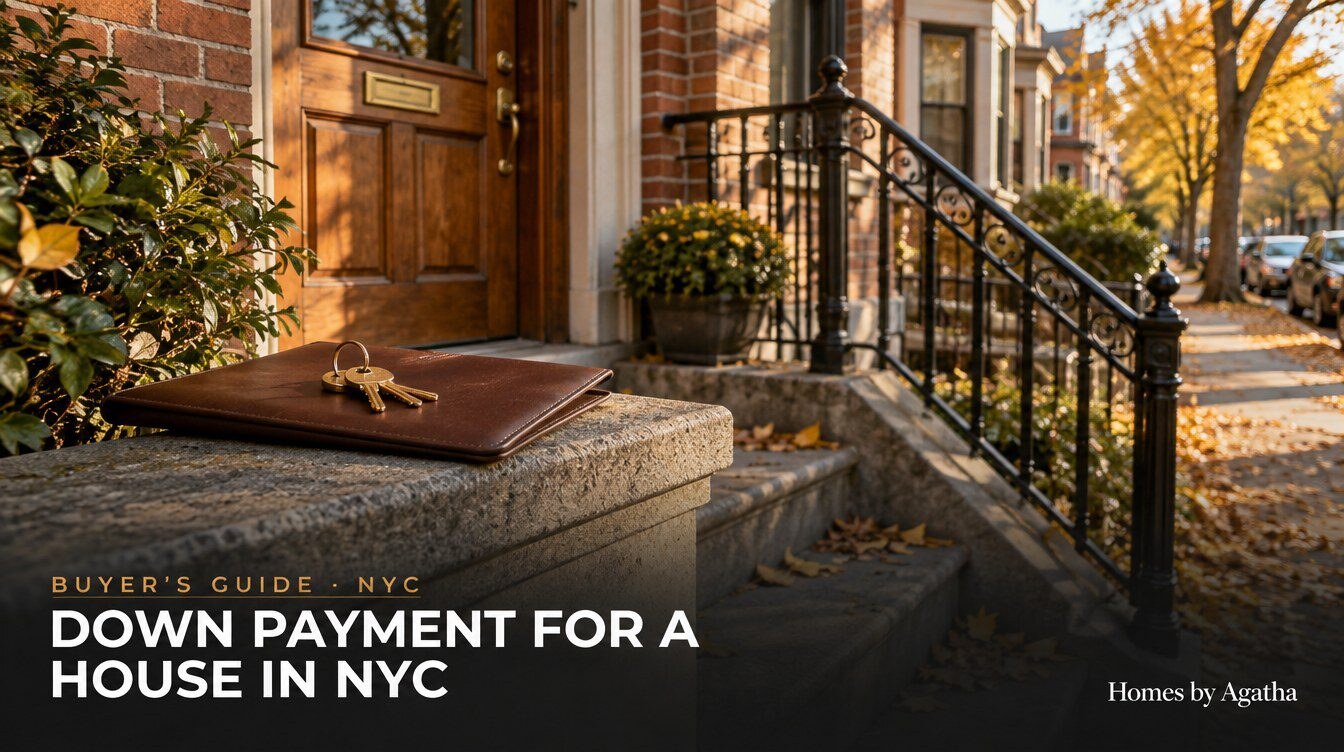
Down Payment for a House in NYC: How Much You Really Need
Quick Answer
The minimum down payment for a house in NYC depends on the loan: 3.5% with FHA, 3% with some conventional programs, and none with an eligible VA loan. Co-op boards often ask for much more. Plan for a contract deposit, customarily 10%, plus closing costs and reserves, which together exceed the down payment itself.
The down payment for a house in NYC is the part of the price you pay from your own money instead of borrowing it. The question most buyers ask first is “how much do I need?”, and the honest answer has two parts. The first part is the legal and lending minimum, which is lower than many people expect. The second part is the cash a New York City purchase actually asks for, which is usually higher than the down payment alone.
This guide is for buyers of houses, two-family homes, condos and co-ops in Queens, Brooklyn and the rest of New York City, with notes for Nassau and Suffolk County. It explains the minimums by loan type, how the contract deposit works, what co-op boards look at, what the HomeFirst and SONYMA assistance programs offer, how gift money is documented, and when each dollar actually leaves your account. I have worked with buyers for 15+ years, in English and Polish, and the advice below follows the order a New York City purchase really runs in.
How much is the down payment for a house in NYC?
There is no single number. The down payment for a house in NYC is set by three things working together: the loan program, the property type, and, for co-ops, the building’s own rules. A lender sets a minimum. A co-op board can set a higher one. A seller and the seller’s attorney can shape how much cash moves at contract signing. You need to meet all three at once.
The down payment in plain words
The down payment is the purchase price minus the loan amount. If you buy a home for a given price and borrow 90% of it, your down payment is the other 10%. Lenders express the same idea as the loan-to-value ratio, or LTV: a 90% LTV loan means a 10% down payment.
Why “20% down” is a habit, not a rule
Many buyers assume 20% is required. It is not a legal requirement for a house or condo in New York. Twenty percent matters because it is the point where a conventional loan no longer needs private mortgage insurance, and because many co-op buildings use it as a floor. Below that line, buyers with the right loan program can and do buy with much less, as the next section shows.
Examples on a sample price
To make the percentages concrete, here is what each common down payment level means on a hypothetical purchase price of $700,000. This is an illustration of the arithmetic, not a market figure; use your own price and your lender’s numbers.
| Down payment | Cash for the down payment | Loan amount | Where it usually applies |
|---|---|---|---|
| 3% | $21,000 | $679,000 | Eligible conventional low-down-payment programs, within loan limits |
| 3.5% | $24,500 | $675,500 | FHA-insured loans |
| 5% | $35,000 | $665,000 | Many conventional loans |
| 10% | $70,000 | $630,000 | Conventional loans; some condos and buildings |
| 20% | $140,000 | $560,000 | No private mortgage insurance on a conventional loan; a common co-op floor |
You can test your own numbers, including how the down payment changes your monthly payment, with the Queens mortgage calculator.
What is the minimum down payment for a house in NYC by loan type?
The minimum down payment for a house in NYC comes from the loan program, not from the city. The same programs apply in Queens, Brooklyn, Nassau and Suffolk, although local prices and property types change which ones fit. The table below summarizes the usual starting points; your lender confirms what you qualify for.
| Loan type | Lowest down payment | Who it fits | What to know |
|---|---|---|---|
| FHA-insured loan | As low as 3.5% | Buyers with smaller savings; owner-occupants of one- to four-unit homes | Mortgage insurance premiums apply; condos usually need an FHA-approved building |
| Conventional low-down-payment programs | As low as 3% for eligible buyers | Often first-time buyers or buyers within income limits | Private mortgage insurance below 20% down |
| Standard conventional loan | Commonly 5% and up | Most buyers with steady income and good credit | Two- to four-family homes usually need more down than a one-family house |
| VA-guaranteed loan | No down payment for eligible borrowers in many cases | Eligible veterans, service members and some surviving spouses | A funding fee may apply; condos need VA approval |
| SONYMA (State of New York Mortgage Agency) loans | Minimum cash contribution of 1% of value; 3% for co-ops and three- or four-family homes | Buyers within the program’s income and price limits | Can be paired with a down payment assistance loan |
| Jumbo and portfolio loans | Set by each lender, usually higher | Loan amounts above conforming limits | Expect stricter reserves |
FHA loans
The U.S. Department of Housing and Urban Development describes FHA’s low down payment as possibly as low as 3.5%. FHA loans carry mortgage insurance premiums, which cost money every month. In the city, FHA works best for one- to four-family houses. For condos, the building generally needs FHA approval, so ask the lender to check the building before you make an offer. FHA financing of co-ops is uncommon in practice, and many co-op boards would not accept a 3.5% down payment anyway.
Conventional loans
Conventional loans follow the rules of the lender and of the agencies that buy most mortgages, Fannie Mae and Freddie Mac. Their low-down-payment programs allow as little as 3% for eligible buyers, often with income limits. Below 20% down, the lender usually requires private mortgage insurance. For a two-family or three-family house, the minimum is usually higher than for a one-family house, so tell your lender the number of units at the start.
VA loans
For eligible veterans and service members, a VA-guaranteed loan can allow a purchase with no down payment, subject to the lender’s underwriting and the appraisal. A one-time funding fee usually applies unless the borrower is exempt. As with FHA, a condo generally needs to be on the VA’s approved list.
Why the cash you need is more than the down payment
The down payment is only the biggest piece of the money you need. Lenders call the full amount “cash to close”, and in New York City it has several layers. Buyers who budget only for the down payment are the ones who have to scramble in the last two weeks.
The layers of cash in a New York City purchase
| Cash item | When it is paid | What decides the amount |
|---|---|---|
| Contract deposit | At contract signing | Customarily 10% of the price in NYC; negotiable through the attorneys |
| Balance of the down payment | At closing | Total down payment minus the deposit already paid |
| Buyer closing costs | At closing | Attorney fee, title insurance, lender fees, recording fees, prepaid taxes and insurance |
| Mortgage recording tax | At closing | A tax on the loan amount when the mortgage is recorded; does not apply to co-op share loans |
| Mansion tax | At closing | Paid by the buyer on residential purchases of $1 million or more |
| Reserves | Kept in your accounts after closing | Lender requirements and, for co-ops, the board’s liquidity rules |
| Up-front costs before contract | Before signing | Inspection, appraisal fee, application fees, co-op package fees |
Two taxes that move with the down payment
The mortgage recording tax is charged on the amount you borrow when a mortgage is recorded. A larger down payment means a smaller loan, and so a smaller tax. Co-op share loans are not recorded mortgages, which is one reason the closing costs for a co-op differ from those for a house or condo. The full breakdown, including transfer taxes and title insurance, is in the guide to Queens closing costs for buyers and sellers.
The mansion tax is a New York State tax on the buyer. According to the New York State Department of Taxation and Finance, an additional tax of 1% applies to the purchase of a residence when the consideration is $1 million or more, and New York City has higher rates for higher-priced purchases. The mansion tax is based on the price, not on the loan, so a bigger down payment does not reduce it.
The 10% contract deposit: the earnest money deposit in NYC
In most of the country, buyers put down a small “earnest money” deposit with the offer. In New York City, nothing is paid when the offer is accepted. Instead, the buyer pays a contract deposit when signing the contract of sale, and it is customary in New York City for that deposit to be 10% of the purchase price. It is held in escrow, usually by the seller’s attorney, until closing, when it is applied to the price.
Deposit and down payment are not the same thing
The contract deposit is part of your down payment, not an extra cost. If you put 20% down, you pay 10% at signing and the other 10% at closing. If you put 10% down, the deposit is your entire down payment and nothing more of it is due at closing. If you put less than 10% down, the usual deposit is larger than your whole down payment, and that is where planning matters.
When your down payment is smaller than 10%
A buyer using an FHA loan with 3.5% down, or a HomeFirst buyer contributing 3% of their own funds, may not have 10% of the price in cash at contract signing. The deposit is negotiable. Your attorney can propose a smaller deposit, such as an amount equal to your planned down payment, and many sellers accept it when the loan commitment and the rest of the offer are solid. Raise it early, ideally when the offer is made, not on the day the contract arrives.
When you can lose the deposit
Once the contract is signed, the deposit is at risk if you default. The contract’s contingencies decide when you can cancel and get it back. The most important one for financed buyers is the mortgage contingency, which normally gives you a set number of days to obtain a loan commitment and lets you cancel with a refund if you cannot. Read it with your attorney. Missing a deadline, or waiving the contingency to make an offer stronger, can turn a loan problem into the loss of the deposit.
Because New York City contracts are signed after the inspection, the inspection report has to be in hand before you pay the deposit. The guide to the home inspection in NYC explains that order step by step.
Planning less than 10% down?
Tell me your loan type and the amount you have saved. I will help you shape the offer so the contract deposit matches your plan, before the attorneys start drafting. Call or text (646) 250-6512.
Co-op down payment requirements in NYC
Co-op down payment requirements are set by each building, and they are usually the strictest part of a New York City purchase. The board does not lend you money, so its minimum is not a lending rule. It is a rule about which shareholders the building is willing to accept, written into the building’s financing policy or applied by the board when it reviews your application.
What the building sets
- Maximum financing: the largest share of the price you are allowed to borrow. Many buildings ask for a down payment well above what a lender would accept, and some do not allow financing at all.
- Post-closing liquidity: how much cash and liquid assets you must still have after paying the down payment and closing costs, often expressed as a number of months or years of maintenance and mortgage payments.
- Debt-to-income limits: how much of your income can go to housing and other debts, sometimes stricter than the lender’s own limit.
The listing or the managing agent can usually tell you the financing limit before you make an offer. Ask for it in writing. It is one of the first things to confirm, because no amount of negotiation with the seller changes the building’s rule.
Why a bigger down payment can hurt a co-op application
Here is the part most guides skip. A buyer who stretches to make a larger down payment, by emptying savings and retirement accounts that count as liquid, can end up with less post-closing liquidity than the board expects. The board then sees a buyer who met the financing limit but has nothing left. For a co-op, the right down payment is the one that meets the building’s minimum and still leaves the cushion the board wants to see. Work out both numbers together before you choose a building.
Where the board checks the numbers
The board package includes your financial statement, bank and brokerage statements, tax returns and the lender’s commitment letter. The board compares your down payment, your remaining assets and your income with its own standards. The steps, documents and timing are covered in the guide to the co-op board approval process in NYC. If you are choosing between a co-op and a condo partly because of cash, the guide comparing a Forest Hills co-op vs condo shows how the two compare on financing and board review.
Down payments for condos, houses and two-family homes
Outside the co-op world, the lender’s minimum usually decides. Still, each property type has its own wrinkles.
Condos
A condo is real property, so the buyer takes a regular mortgage and the lender’s rules apply. The building matters too. Lenders review the condominium itself, including owner-occupancy levels, the reserve fund and any litigation, and some buildings do not meet the requirements for the lowest-down-payment programs. In those cases the lender may ask for a larger down payment or decline the building. New-development condos sell through an offering plan, which also sets the deposit terms. The guide to buying a condo in Long Island City walks through a typical condo purchase in Queens.
One-family houses
For a one-family house, the full range of programs is available: FHA, conventional low-down-payment loans, VA and SONYMA. The house has to appraise at or near the price, because the lender bases the loan on the lower of the price and the appraised value. If the appraisal comes in low, the loan shrinks and the difference has to come from your cash or from a price change.
Two-family and multi-family homes
Two-family houses are common in Queens and Brooklyn, and many buyers want one for the rental income. FHA allows owner-occupants to buy one- to four-unit homes, and SONYMA’s minimum cash contribution rises to 3% for three- and four-family homes. Conventional loans for two- to four-unit homes usually require a larger down payment than for a one-family house. Lenders may count part of the expected rent as income, but only for units that are legal on the Certificate of Occupancy. The guide to buying a multi-family home in Queens explains how the legal unit count, leases and lender rules fit together, and the guide to buying a two-family home in South Richmond Hill applies them to one neighborhood.
Should you put 20% down? PMI and the trade-offs
Putting 20% down on a conventional loan removes private mortgage insurance, lowers the loan amount and lowers the mortgage recording tax. It also ties up cash you may need for repairs, furniture and reserves. The right answer depends on your savings, the property and how long you plan to stay.
How private mortgage insurance works
Private mortgage insurance, or PMI, protects the lender, not you. On a conventional loan, PMI may be required when the down payment is less than 20% of the price. The rules for ending it are set by federal law. According to the Consumer Financial Protection Bureau, you can ask the servicer to cancel PMI once the balance is scheduled to reach 80% of the home’s original value, if you meet the conditions, and the servicer generally must end it automatically when the balance is scheduled to reach 78%, as long as you are current on payments. FHA and VA loans follow their own rules.
Arguments for a smaller down payment
- You keep cash for closing costs, moving and early repairs, which older Queens houses often need.
- You keep reserves, which lenders and co-op boards both look at.
Arguments for a larger down payment
- A smaller loan, a lower monthly payment and less interest over the life of the loan.
- No PMI on a conventional loan at 20% or more.
- A stronger offer in a competitive situation, because sellers see less financing risk.
A useful middle path is to decide on the reserves you want to keep first, and then put the rest toward the down payment. That order protects you from buying a home you cannot maintain.
Down payment assistance in NYC: the HomeFirst program
New York City’s main down payment assistance program is HomeFirst, run by the Department of Housing Preservation and Development (HPD). According to the HPD HomeFirst program page, it offers qualified first-time buyers up to $100,000 toward the down payment or closing costs on a home in the five boroughs.
Who qualifies
- First-time homebuyers buying a home to live in.
- Household income up to 120% of Area Median Income. HPD lists maximum incomes effective June 1, 2026, including $142,560 for a one-person household, $162,840 for two people, $183,240 for three and $203,520 for four.
- Homebuyer education: a course taught by an HPD-approved counseling agency.
- Your own contribution: at least 3% of the purchase price from your own funds, applied as a down payment or contract deposit, plus savings for the rest of the down payment or closing costs.
- Eligible homes: a one- to four-family home, a condo or a co-op in New York City.
How the assistance is repaid or forgiven
HomeFirst assistance is structured as a forgivable loan tied to living in the home. HPD requires owner-occupancy for 10 years when the assistance is $40,000 or less, and for 15 years when it is more than $40,000. Selling or moving out early can mean repaying part of it, so read the terms with your attorney before you sign.
How to apply
- Contact an HPD-approved housing counseling agency, complete the education course and the HomeFirst application; the agency certifies your income.
- Get pre-approved by a lender that participates in the program.
- Find a home with a real estate professional; it must pass a Housing Quality Standards inspection before the purchase.
- Hire a real estate attorney and negotiate the contract of sale.
Start the counseling step before you shop. The timing of the inspection and the funding has to fit inside your contract dates, and the seller’s attorney will want to know early that a program is involved.
Using HomeFirst or SONYMA?
Programs add steps and dates to the contract. I can help you line up the counseling agency, the participating lender and the attorney so your offer is ready when the right home appears. Call or text (646) 250-6512.
SONYMA down payment assistance across New York State
The State of New York Mortgage Agency, SONYMA, offers mortgages through participating lenders across the state, including New York City, Nassau and Suffolk. Its Down Payment Assistance Loan, or DPAL, can be added to a SONYMA mortgage.
DPAL terms
According to New York State Homes and Community Renewal, the DPAL:
- ranges from $1,000 up to the greater of 3% of the purchase price (capped at $15,000) or $3,000, and cannot exceed your actual down payment and closing costs;
- carries 0% interest and no monthly payments, and is forgiven after 10 years, with the amount you would repay on an early sale or refinance dropping by 1/120 for each month you live in the home;
- raises the interest rate on the SONYMA mortgage by 0.40%, except for the Graduate to Homeownership, Homes for Veterans and ENERGY STAR programs;
- requires a minimum cash contribution from the buyer of 1% of the property’s value, or 3% for co-ops and three- and four-family homes.
HCR also describes a limited, enhanced version for 2026, DPAL PLUS, for households up to 60% of Area Median Income, which can cover up to $30,000 of down payment, closing costs and single-premium mortgage insurance, with funds available on a first-come, first-served basis. Not every SONYMA lender offers DPALs, so ask the lender directly.
For a wider view of the first purchase, from pre-approval to keys, read the first-time home buyer guide for Queens.
Where your down payment can come from
Lenders care about the source of every dollar of the down payment, not just the total. Money that appears in your account without a paper trail can stop an approval. Plan the source of the money as carefully as the amount.
Acceptable sources lenders usually see
| Source | What the lender usually asks for | Watch out for |
|---|---|---|
| Savings and checking | Recent statements for every account used | Large deposits that are not payroll need an explanation |
| Gift from a family member | A signed gift letter and proof of the transfer | Program rules on who can give; the gift cannot be a disguised loan |
| Investment accounts | Statements and proof of the sale or withdrawal | Market swings between pre-approval and closing |
| Retirement accounts | Statements and the terms of any withdrawal or loan | Taxes and penalties; co-op boards may count these differently |
| Sale of a current home | The contract and settlement statement of that sale | Timing of two closings |
| Assistance programs | Program approval and documents | Program-specific minimum contributions |
Gift money
Gifts from family are common for first purchases in New York. The lender will want a gift letter stating the amount, the relationship and that no repayment is expected, plus a record of the money moving from the giver’s account to yours. Programs differ on who may give and on how much of the down payment can be a gift, so check before the money moves. Co-op boards may also ask about gifts in the board package, and some prefer to see funds that are clearly yours.
Proof of funds when you make an offer
In New York City, a serious offer usually comes with two documents: a pre-approval letter from a lender and proof that you have the cash for the down payment and closing costs. Sellers and listing agents use them to compare offers, especially when two buyers offer similar prices.
What a clean proof of funds looks like
- A recent statement for each account you will use, with account numbers partly hidden.
- Totals that cover the down payment, the closing costs and, for co-ops, the post-closing liquidity the building expects.
- For gift money, a note that a gift is part of the plan; the gift letter itself comes later for the lender.
Pre-approval versus commitment
A pre-approval is the lender’s early review of your income, credit and assets. A loan commitment comes later, after the contract, the appraisal and full underwriting. Your down payment plan has to survive both, so share the real source of funds with the lender at the pre-approval stage rather than at commitment. The sequence from offer to closing is in the NYC home buying process guide, and the guide to working with a buyer’s agent in NY explains how your agent presents the offer.
A sample cash plan for a Queens purchase
The clearest way to see the gap between the down payment and the cash you need is to lay out the payments in order. The example below uses a hypothetical one-family house in Queens at $700,000, financed with a conventional loan and 10% down. The closing cost and reserve lines are placeholders; your lender’s loan estimate and your attorney’s estimate replace them with real numbers.
| Step | Payment | Amount in this example |
|---|---|---|
| Before contract | Inspection, appraisal and application fees | From your quotes |
| Contract signing | Contract deposit (10% of price) | $70,000 |
| Closing | Balance of the down payment | $0, because the deposit already equals 10% |
| Closing | Buyer closing costs, including mortgage recording tax on a $630,000 loan | From your attorney’s estimate |
| After closing | Reserves the lender requires | From your lender |
The same house with 5% down
With 5% down, the down payment is $35,000 and the loan is $665,000. If the seller’s attorney expects a 10% deposit, you would owe $70,000 at signing, which is more than your entire down payment. That is the moment to negotiate a $35,000 deposit instead. The loan is larger, so the mortgage recording tax is higher, and PMI applies on a conventional loan.
The same house with 20% down
With 20% down, the down payment is $140,000: $70,000 at signing and $70,000 at closing. The loan is $560,000, with no PMI on a conventional loan and a lower recording tax. The cost is liquidity: you need enough left after closing for reserves and for the first repairs an older house will ask for.
Want your own cash plan?
Send me your target price range, property type and savings. I will help you build a step-by-step cash plan you can take to your lender and attorney before you start making offers. Call or text (646) 250-6512.
Down payments in Nassau and Suffolk County
On Long Island, most purchases are one-family houses financed with regular mortgages, so the lender’s minimum usually decides the down payment. FHA, conventional low-down-payment loans, VA and SONYMA are all available. HomeFirst is a New York City program and does not apply to purchases in Nassau or Suffolk.
What changes outside the city
- Deposit customs: contract deposits are negotiated through the attorneys, as in the city; ask your attorney what is usual for the price and the area.
- Property taxes and escrow: higher property tax bills mean a larger monthly escrow and a larger prepaid amount at closing, which adds to the cash you need.
- Local programs: some counties, towns and villages run their own first-time buyer programs; ask a HUD-approved housing counseling agency what applies where you are buying.
For the full Long Island picture, read the guides to buying a house in Nassau County and buying a house in Suffolk County.
When does each dollar leave your account?
Knowing the order of payments helps you keep the right money in the right account at the right time. A typical financed purchase in New York City runs like this.
- Pre-approval: no payment yet, but the lender reviews the accounts the down payment will come from. Keep them stable from now on.
- Accepted offer: no deposit in New York City at this stage. Book the inspection and pay the inspector.
- Contract signing: the contract deposit goes into escrow, usually with the seller’s attorney. This is the first large payment.
- Loan application and appraisal: the lender collects application and appraisal fees and asks for updated statements.
- Co-op board package: application and processing fees are paid to the managing agent; the board reviews your assets after the down payment.
- Before closing: the lender issues the Closing Disclosure with the final cash to close. Arrange the wire or certified checks your attorney asks for, and confirm wiring instructions by phone with your attorney’s office.
- Closing: the balance of the down payment and the closing costs are paid; the deposit is released from escrow and applied to the price.
- After closing: reserves stay in your accounts. For co-ops, that is the liquidity the board approved you with.
How long each step usually takes, and which ones run at the same time, is laid out in the guide to how long it takes to close on a house in NYC.
Common down payment mistakes in New York City
Most down payment problems are not about the amount. They are about timing, documents and assumptions. These are the ones that come up most often.
- Budgeting only for the down payment. Closing costs, the mortgage recording tax and reserves come on top.
- Assuming the deposit equals the down payment. A 10% deposit on a 5% down payment plan needs to be negotiated before the contract.
- Choosing a co-op before checking its financing limit. The building’s rule can rule you out, whatever the lender says.
- Draining liquid savings for a bigger down payment. Lenders and boards both look at what remains.
- Moving money without a paper trail. Undocumented deposits create delays at underwriting.
- Starting an assistance program too late. Counseling, education and program approval take time that the contract dates do not wait for.
- Waiving the mortgage contingency to compete. It can put the whole deposit at risk if the loan falls through.
Choosing where to buy also changes the math: property types, prices and building rules differ across the borough. The guide to the best Queens neighborhoods for first-time buyers compares options by housing type, and the guide to buying a home in Brooklyn does the same for Brooklyn.
Key Takeaways
- The minimum down payment for a house in NYC comes from the loan: as low as 3.5% with FHA, 3% with some conventional programs, and none with an eligible VA loan.
- Co-op buildings set their own financing limits and post-closing liquidity rules, usually stricter than any lender’s.
- A contract deposit, customarily 10% in NYC, is paid at signing and counts toward the down payment; it can be negotiated down when your down payment is smaller.
- Cash to close also includes closing costs, the mortgage recording tax, the mansion tax at $1 million or more, and reserves.
- HomeFirst offers qualified first-time buyers up to $100,000 in New York City; SONYMA’s DPAL is available across the state through participating lenders.
Frequently asked questions about the down payment for a house in NYC
What is the minimum down payment for a house in NYC?
It depends on the loan. FHA loans allow as little as 3.5%, some conventional programs allow 3% for eligible buyers, and eligible veterans may buy with no down payment through a VA loan. Co-op buildings usually require much more, and the lender confirms what you qualify for.
How much do you need for a down payment on a house in NYC?
Plan for more than the down payment itself. Add a contract deposit, customarily 10% of the price at signing and counted toward the down payment, plus buyer closing costs, the mortgage recording tax on financed purchases, the mansion tax at $1 million or more, and the reserves your lender or building expects.
Do you need 20% down to buy a co-op in NYC?
Each co-op sets its own financing limit, and many buildings ask for a large down payment; some do not allow financing at all. Boards also look at the liquid assets you keep after closing. Ask the listing agent or managing agent for the building’s financing policy before you make an offer.
Is the earnest money deposit in NYC the same as the down payment?
The contract deposit is part of the down payment, not an extra cost. It is customarily 10% of the price, paid when the contract is signed and held in escrow until closing. If your down payment is smaller than 10%, your attorney can negotiate a smaller deposit.
Who qualifies for down payment assistance in NYC?
HPD’s HomeFirst program serves first-time buyers with household income up to 120% of Area Median Income who complete homebuyer education and contribute at least 3% of the price from their own funds. It offers up to $100,000 for a one- to four-family home, condo or co-op in the five boroughs.
Can I use gift money for a down payment in New York?
Usually, yes. Lenders generally accept gifts from family with a signed gift letter and proof of the transfer, but loan programs differ on who may give and how much can be a gift. Co-op boards may also ask about gifts, so tell your lender and agent early.
Summary and your next step
The down payment for a house in NYC starts with your loan program and ends with the cash you actually move: a contract deposit at signing, the balance at closing, closing costs and reserves. Check the building’s rules if you are buying a co-op, look at HomeFirst and SONYMA if you are a first-time buyer, and plan the deposit before the contract arrives. If you are buying in Queens, Brooklyn or Long Island, reach out and I will help you build a cash plan around your price range. For help in Polish, visit the page for a Polish-speaking real estate agent in Queens.
This article is for general informational purposes only and reflects conditions that may change. It is not legal, tax, lending or financial advice; loan programs, assistance terms and income limits change, and your lender, a licensed New York real estate attorney and a HUD-approved housing counseling agency should confirm what applies to your purchase. Program and tax rules described here reflect the cited government sources as of October 2026. Real estate brokerage services are offered by Agatha Lubas, Licensed Associate Real Estate Broker, NY License #10301213345, Keller Williams Realty Liberty, 96-10 101st Avenue, Ozone Park, NY 11416. The NYS Disclosure Form for Buyer and Seller, the NYS Housing and Anti-Discrimination Disclosure / Fair Housing Notice, and the brokerage’s Standard Operating Procedures are available on request. Equal Housing Opportunity.

Agatha Lubas works with buyers and sellers throughout Queens, Brooklyn, Nassau County and Suffolk County, coordinating lenders, attorneys, inspectors and managing agents from the first offer to closing day. She serves clients in English and Polish.
Work with Agatha